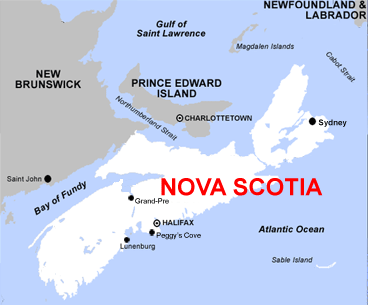
Halifax & Lunenburg - 6 hours - $240
Equivalent cost per person:
1 Passenger |
2 Passengers |
3 Passengers |
4 Passengers |
5 Passengers |
6 Passengers |
$240/person |
$120/person |
$80/person |
$60/person |
$48/person |
$40/person |
Halifax :
- Pier 21 Museum : an immigration facility from 1928 to 1971 in which one million immigrants went through and 500,000 Canadian military personnel departed from during World War II.
- Westin Hotel : built circa 1930, has 297 rooms and is the largest of the older hotels in Halifax.
- Old Burying Ground : First European cemetary of Halifax.
- Government House : Completed in 1805.
- Lord Nelson Hotel : built in 1928 and has 244 rooms.
- Public Gardens : a 7 hectare/17 acre Victorian style garden started in 1837.
- Halifax Citadel : a National Historic Site. A military fortification built between 1828 and 1856 and dominates the Halifax downtown.
- Halifax Common : a park of open green space that was created in 1760 and has 30 hectares/70 acres.
- Halifax Downtown : much of the downtown area was layed-out in 1749..
- St. Paul's Church : is the oldest existing building in Halifax and was built in 1750.
- City Hall : built in 1889.
- Granville Mall : a pedestrian plaza constructed after a major fire in 1859 in a Victorian-Italianate style.
- Province House : houses the Nova Scotia Legislature and was built between 1811 and 1818.
- Halifax-Dartmouth Ferry : started in 1752 and is the oldest continually operating salt water ferry in Canada and the USA.
- Naval Clock : the clock was built in 1767 in London and originally was located in the Halifax Naval Dockyard from 1772 to 1993.
- Fairview Lawn Cemetary : RMS Titanic victims graves.
Lunenburg :
The first European settlement was in 1753 with German, Swiss, and French settlers. Lunenburg is famous for its waterfront, fishing industry, vessel building and architecture.
Lunenburg had a large 'banks' fishery, inwhich sailing vessels travelled 200-400km/150-250mi to fish on the ocean. Circa 1900 the Lunenburg 'banks' fishery had 180 vessels which employed 2000 fishers.
Hundreds of wooden sailing vessels were built in Lunenburg. Four famous vessels are as follows : 1) Bluenose, built in 1921, a fishery schooner which became a racing champion, 2) Bounty, in 1960 the 'Bounty 'was launched as a replica of the HMS Bounty for the MGM film 'Mutiny on the Bounty', 3) Bluenose II, built in 1963 as a replica of the original Bluenose which sank in 1946, 4) HMS Rose, a replica of the Royal Navy warship during the American War of Independence, was built in 1976 for the USA bicentenary celebrations and was used for the 2003 film 'Master and Commander'.
Lunenburg's 'Old Town' is a good example of British settlement in North America. It's historic buildings and homes date back to the 1760's. In 1995 the United Nations declared Lunenburg's 'Old Town' area a UNESCO World Heritage site (there are 469 World Heritage sites of which 12 are in Canada). There are about four hundred 'Old Town' buildings.
Mahone Bay :
An interesting small town with an array of studios and galleries.
Oak Island :
A mystery that is two hundred years old. Something valuable was buried on the island and as of yet has not been discovered.
Chester :
A historic seaside village.
|